I recently watched Helen Fisher’s TED Talk, Why We Love, Why We Cheat, and I have not stopped thinking about it since.
Fisher is a biological anthropologist who has spent decades studying romantic love, not as a poet or a philosopher, but as a scientist. She puts people inside MRI machines and watches what their brains do when they look at a photograph of someone they are madly in love with. What she finds is extraordinary, and if you have ever fallen in love, or fallen out of it, or watched someone you care about do either, her work will resonate with you in ways that are difficult to shake.
Let me share what struck me most, and why I think it matters for anyone trying to understand themselves, their relationships, or the people they love.
Love Is Not an Emotion. It Is a Drive.
This is the idea I keep returning to.
Most of us think of love as something we feel. An emotion that rises and falls, that we move in and out of, that we can perhaps manage if we are disciplined enough. Fisher’s brain scan data suggests something far more challenging than that.
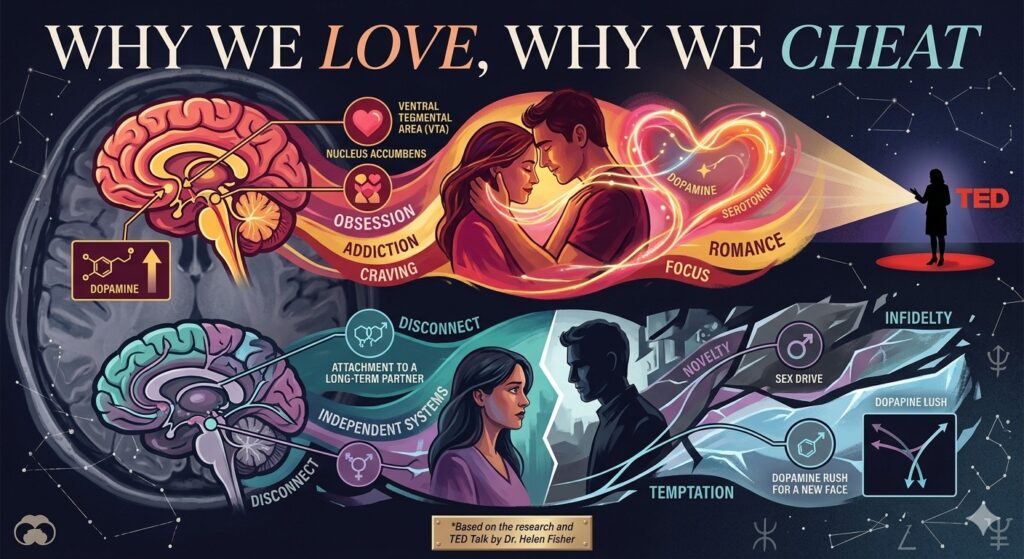
When her subjects looked at photographs of their romantic partners, the brain region that lit up was the same one that activates during a cocaine rush. Not the emotional centers of the brain. The reward circuitry. The wanting, craving, motivational engine that drives us toward things we need.
Fisher’s conclusion: romantic love is a drive, as fundamental as hunger or thirst. It comes from the motor of the mind, not the feeling centers.
This reframes everything. It means that when someone is in the grip of early romantic love, telling them to “be rational” or “think clearly” is a little like telling someone who has not eaten in three days to stop thinking about food. The craving is not a choice. It is a biological state.
In my clinical work, I find this framing genuinely useful. When clients come to me confused or ashamed about the intensity of what they feel for someone, whether love or heartbreak or obsession, it helps to understand that they are not weak or irrational. They are human, with a brain that was designed over millions of years to pursue deep emotional bonding with extraordinary force.
Three Systems, Not One
Fisher describes three distinct brain systems involved in mating and reproduction, and understanding how they differ from each other explains a great deal about why love is so complicated.
The first is the sex drive: the general craving for sexual gratification. It is diffuse, can be directed at many people, and exists largely independently of emotional connection.
The second is romantic love: the intense, obsessive, euphoric focus on a specific individual. The “special meaning” Fisher describes, where one person’s car in a parking lot looks different from every other car. Where you think about them all day and most of the night.
The third is attachment: the calm, stable, deeply rooted sense of security and belonging that develops with a long-term partner over time.
Here is the thing that makes this so clinically important: these three systems do not always point at the same person.
You can feel deep attachment to a long-term partner while experiencing intense romantic love for someone else entirely. You can have a strong sex drive without romantic feelings, or profound romantic love without much sexual desire. These circuits run in parallel, and they do not always cooperate.
This is not a moral failing. It is neurobiology. And understanding it does not excuse harmful behavior, but it does help us understand the internal landscape that people are navigating when they come to therapy in pain, confused about why they feel what they feel when it seems to contradict everything they value and want.
The Rickshaw Story
Fisher ends her talk with a story I found both funny and quietly profound.
A graduate student was in love with a female colleague who did not feel the same way. He knew from Fisher’s research that novel, exciting experiences drive up dopamine in the brain, the same chemical associated with romantic love. So he invited her on a rickshaw ride through the chaotic streets of Beijing, weaving between buses and trucks, the kind of experience that gets your heart pounding and your senses alive.
An hour later, she stepped off the rickshaw, laughing and exhilarated. She threw her hands up and said, “Wasn’t that wonderful? And wasn’t that rickshaw driver handsome!”
The dopamine had worked. It had just attached itself to the wrong person.
I laughed at that. But it also captures something real about how love forms and why proximity, timing, and shared experience matter so much. The brain does not fall in love in a vacuum. Context shapes everything.
What This Means for Relationships
Fisher’s research carries some genuinely useful implications for anyone trying to build or repair a relationship.
Novelty matters more than most couples realize. The early intensity of romantic love is partly fueled by dopamine, and dopamine responds strongly to new experiences. As relationships settle into comfortable routine, that chemical novelty fades. This is normal and not a sign that love has died. But deliberately introducing new shared experiences, travel, creative projects, unfamiliar situations, can reactivate some of that early energy in a way that is not superficial at all. It is neurologically grounded.
Infatuation is temporary by design. The obsessive, all-consuming quality of early romantic love does not last, and Fisher’s work suggests it was never meant to. It exists to pull two people together with enough force to begin building something. The deeper attachment that follows is a different brain system, quieter and more stable, but no less real.
Heartbreak is a form of withdrawal. Fisher’s scans of people who had just been rejected in love showed brain activity consistent with craving and addiction. Understanding this helps explain why breakups can feel so physically unbearable, and why people return to relationships that are clearly not good for them. The brain is in genuine withdrawal from a chemical it had come to depend on.
A Note on Antidepressants
Fisher raises a concern near the end of her talk that I think deserves mention, because it comes up in clinical settings more than people realize.
SSRIs, the class of antidepressants most commonly prescribed globally, work by raising serotonin levels. Raising serotonin suppresses the dopamine circuit. Dopamine, as we now know, is the core chemical of romantic love. SSRIs also commonly reduce libido and the capacity for orgasm, which in turn affects the oxytocin and vasopressin pathways associated with bonding and attachment.
Fisher is not arguing against antidepressants. Neither am I. There are situations where they are genuinely necessary and life-saving. But the concern she raises is worth holding: when we chemically adjust one brain system, we affect the others. For people who are on long-term antidepressant treatment and finding that their relationships feel flat, or that emotional intimacy feels harder to access, this is a conversation worth having with their doctor and with a therapist.
Why I Find This Work Valuable
I work with people every day who are in pain around love. Couples who have lost each other. Individuals trying to make sense of feelings that seem to contradict their own values. People grieving the end of something that felt irreplaceable.
What Fisher’s work offers, and what I try to offer in my practice, is a framework that replaces shame with understanding. You are not weak because love overwhelmed you. You are not broken because you felt things you could not control. You are not strange because attachment and desire and romantic feeling have all pulled you in different directions at once.
You are human. With a brain that evolved over millions of years, shaped by pressures and needs that predate civilization, doing exactly what it was built to do.
The work is learning to understand that brain well enough to make choices that reflect your actual values, your actual life, and the relationships you genuinely want to build.
That is what therapy is for. And that is, I think, what Helen Fisher spent her career helping us understand.
If questions about love, relationships, or emotional wellbeing are something you are navigating, I offer individual and couples counseling online and in person at my Lahore clinic. You are welcome to reach out.