There is a strange irony at the heart of modern education. We spend years being taught subjects, languages, formulas, and facts, but almost no one ever teaches us how to actually learn. How memory works. Why some things stick and others vanish by morning. How to study in a way that builds genuine understanding rather than the illusion of it.
The result is that most people carry inefficient learning habits for their entire lives, not because they are not intelligent, but because no one ever handed them the manual.
This is that manual.
What Does It Mean to “Learn” Something?
Learning is not the same as exposure. Reading something once, sitting in a lecture, or watching a video does not mean you have learned it. True learning means the information has been encoded into long-term memory in a way that you can retrieve and use it later.
That process, from exposure to encoding to retrieval, is where most people’s strategies break down. We confuse familiarity with knowledge. When something feels familiar after re-reading it, we assume we know it. But familiarity and recall are completely different cognitive processes. One feels like learning. Only the other actually is.
Understanding this distinction is where better learning begins.
How Your Brain Actually Learns
Your brain does not store information the way a hard drive does. It stores it in networks of connected neurons. The more connections a piece of information has to things you already know, the more firmly it is encoded and the easier it is to retrieve.
This is why learning in isolation is harder than learning in context. A random fact is difficult to retain. The same fact, connected to a story, an emotion, a personal experience, or an existing idea, becomes far stickier.
A few key principles govern how this works:
The Spacing Effect: Your brain consolidates memories during rest, not during study. Cramming works in the short term because your brain can hold information in working memory. But without spaced repetition, most of it is gone within 48 hours. Distributing your study across multiple sessions over days or weeks produces dramatically better long-term retention.
The Testing Effect: Being tested on material, or testing yourself, strengthens memory far more than re-reading or reviewing it. Every time you retrieve a memory, you reinforce the neural pathway that stores it. This is called retrieval practice, and it is one of the most well-supported findings in cognitive psychology.
Interleaving: Most people study one topic until they feel comfortable with it, then move to the next. Research shows that mixing topics within a study session, even though it feels harder and less satisfying in the moment, produces better long-term retention and the ability to apply knowledge flexibly.
The Generation Effect: Information you generate yourself is better remembered than information you passively receive. Writing a summary in your own words, explaining a concept aloud, or solving a problem before being shown the answer all engage this effect.
Why Most Common Study Habits Do Not Work
Highlighting, re-reading, and summarizing notes are the most popular study strategies among students and learners worldwide. They are also among the least effective, according to decades of cognitive science research.
The reason is that they feel productive without actually being productive. Re-reading a page of notes creates fluency, the sense that you understand it, without requiring your brain to do the hard work of retrieval. It is the cognitive equivalent of watching someone else exercise and feeling like you got a workout.
The strategies that feel harder, testing yourself, spacing out sessions, forcing yourself to recall without looking at notes, are the ones that actually build durable knowledge. Difficulty during learning is often a signal that real encoding is happening.
Techniques That Actually Work
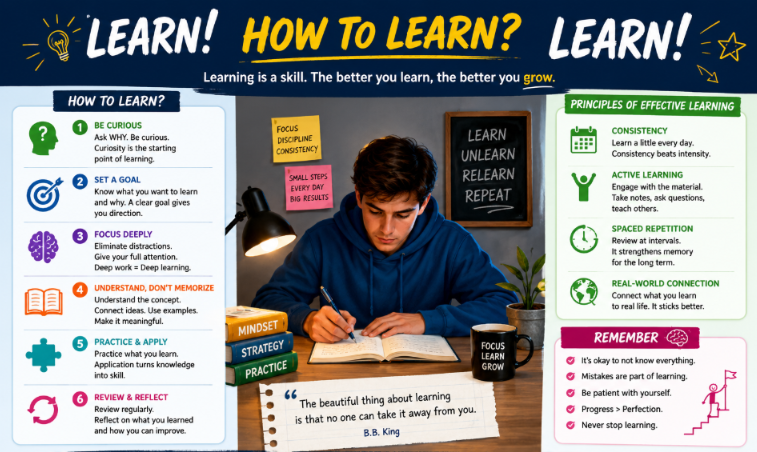
1. Active Recall
Close the book. Put away your notes. Then write down, from memory, everything you can recall about what you just studied. This is uncomfortable. It is also one of the single most effective things you can do to move information from short-term to long-term memory. Do this after every study session, not just before an exam.
2. Spaced Repetition
Instead of reviewing material once, review it at increasing intervals. Look at it the day after learning it, then three days later, then a week later, then two weeks later. Each review resets the forgetting curve and deepens the memory trace. Flashcard apps built around spaced repetition algorithms can automate this process efficiently.
3. The Feynman Technique
Choose a concept you want to understand. Explain it out loud or in writing as if you were teaching it to someone with no background in the subject. Wherever your explanation breaks down or becomes vague, that is exactly where your understanding has a gap. Go back to the source material and fill it. Then explain again. Repeat until the explanation is clear, simple, and complete.
This technique was developed by Nobel Prize-winning physicist Richard Feynman, who believed that if you cannot explain something simply, you do not truly understand it.
4. Interleaved Practice
Rather than blocking your study time by topic, mix it up. If you are studying three subjects, rotate between them within a single session. If you are practicing a skill, vary the type of problems or exercises rather than drilling one type repeatedly. The added challenge is the point.
5. Elaborative Interrogation
Ask yourself why. When you encounter a fact or concept, do not just accept it. Ask why it is true, how it connects to what you already know, and what would happen if it were different. Generating explanations deepens encoding because you are building more connections in the network where the memory lives.
6. Sleep as a Learning Tool
Sleep is not downtime for the brain. It is when the hippocampus replays the day’s learning and transfers it into long-term cortical storage. Cutting sleep to study more is almost always counterproductive. A well-rested brain retains more from two hours of focused study than an exhausted brain retains from five.
The Role of Mindset in Learning
How you think about your own ability to learn shapes how much you actually learn. Psychologist Carol Dweck’s research on mindset found a consistent pattern: people who believe intelligence is fixed, that you either have it or you do not, tend to avoid challenges, give up sooner, and learn less over time. People who believe ability can be developed through effort approach difficulty as information rather than judgment.
The practical implication is straightforward. When something is hard to learn, that is not a signal that you cannot learn it. It is a signal that your brain is doing real work. Reframing difficulty as progress rather than failure changes your relationship with the entire process.
Curiosity also matters more than motivation. Motivation fluctuates. Curiosity, when cultivated, sustains learning through the hard patches. Finding the genuine question behind what you are studying, the thing you actually want to know, gives the learning process direction and energy that discipline alone cannot provide.
Learning as a Lifelong Practice
Formal education ends. Learning does not have to.
The most capable people across every field, from medicine to business to the arts, are not necessarily the ones who were the most talented at the start. They are the ones who kept learning after everyone else stopped. Who read widely, stayed curious, sought out feedback, and were willing to be beginners again whenever a new skill was worth acquiring.
The good news is that learning how to learn is itself a learnable skill. The brain remains plastic across a lifetime. New neural connections can form at any age. The strategies that work for a twenty-year-old student work equally well for a fifty-year-old professional picking up something entirely new.
You are never too late, too old, or too set in your ways to become a better learner. You just need a better approach.
When Learning Feels Impossible
Sometimes the barrier to learning is not technique. It is something deeper. Chronic anxiety, attention difficulties, low mood, past academic trauma, or burnout can all make concentration and retention genuinely harder, regardless of how good your study habits are.
If you consistently find that your mind will not cooperate, that focus is elusive, that motivation has collapsed entirely, or that learning feels overwhelming rather than just challenging, it may be worth speaking to a mental health professional. Cognitive and emotional barriers to learning are real, they are addressable, and they are not a reflection of your intelligence or potential.
Talk to Dr. Muhammad Danial Sohail
Dr. Muhammad Danial Sohail is a Psychotherapist, Counsellor, and Social Psychologist with over 15 years of experience across Asia, Europe, and the Middle East. He works with individuals navigating anxiety, attention difficulties, burnout, and the psychological blocks that make growth feel out of reach.
If your mind is getting in the way of the life you want to build, professional support can help clear the path.
Sessions are available online via WhatsApp video or audio, or in person at Dr. Danial’s Lahore clinic.
Online Consultation: Contact via WhatsApp
In-Person (Lahore): 📍 28-A, Jail Road, opposite Kinnaird College, Shadman II, Lahore